ReTracing

An Archaeological Approach Through Body, Machine, and Generative Systems

Authors

Yitong Wang
Department of Machine Learning
Carnegie Mellon University
yitongw2@cs.cmu.edu


Yue Yao
SIPA Technology Policy and Innovation
Columbia University
yy3462@columbia.edu
LinkedIn  /  CV
ReTracing

Abstract

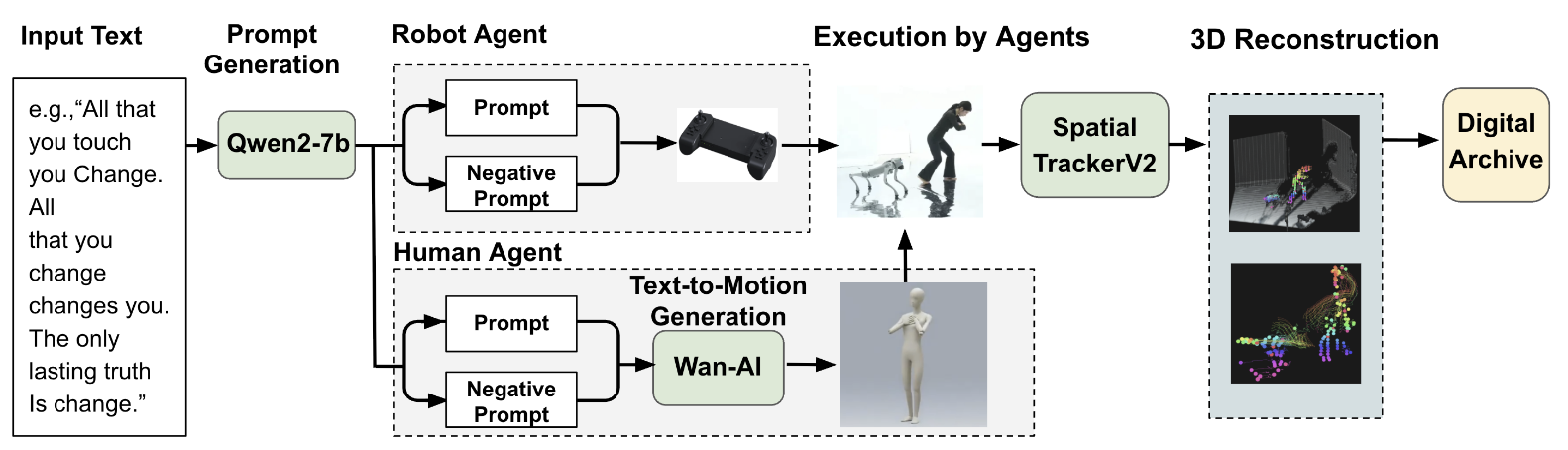
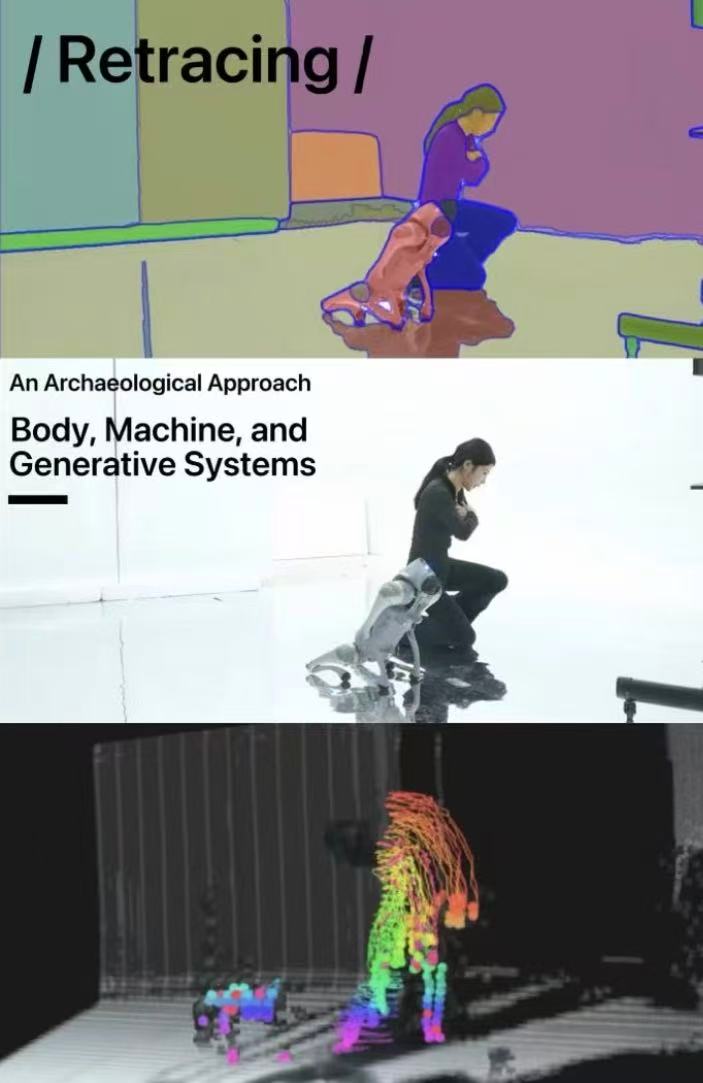
ReTracing is a multi-agent embodied performance art adopting an archaeological approach to examine how artificial intelligence shapes and produces bodily movement. Drawing from science-fiction novels, large language models generate paired prompts—“what to do” and “what not to do”—which diffusion-based models transform into choreographic guides for human performers and motor commands for quadruped robots. The mirrored stage and motion tracking create a 3D digital archive of movement, reflecting how generative systems encode socio-cultural biases through choreographed embodiment.

>
Paper (PDF)

Video Highlights

Framework

ReTracing integrates text, motion, and embodiment through three key components:

ReTracing Framework Diagram

Conceptual Themes

ReTracing treats AI as both a generative and performative system — not just producing movement but encoding cultural, ethical, and aesthetic constraints.

By examining how prompts shape choreography and robotic control, this project engages with the Archaeology of AI — excavating the algorithmic logic behind embodiment and control.